A chess piece drawn at card size has half a second to tell you what it is. A bishop at thumbnail scale needs to read as a bishop before a player across the table picks it up. That is the same problem character design solves on a mobile store listing, except the screen is now a card held in someone's hand, lit by whatever bulb hangs over the table.
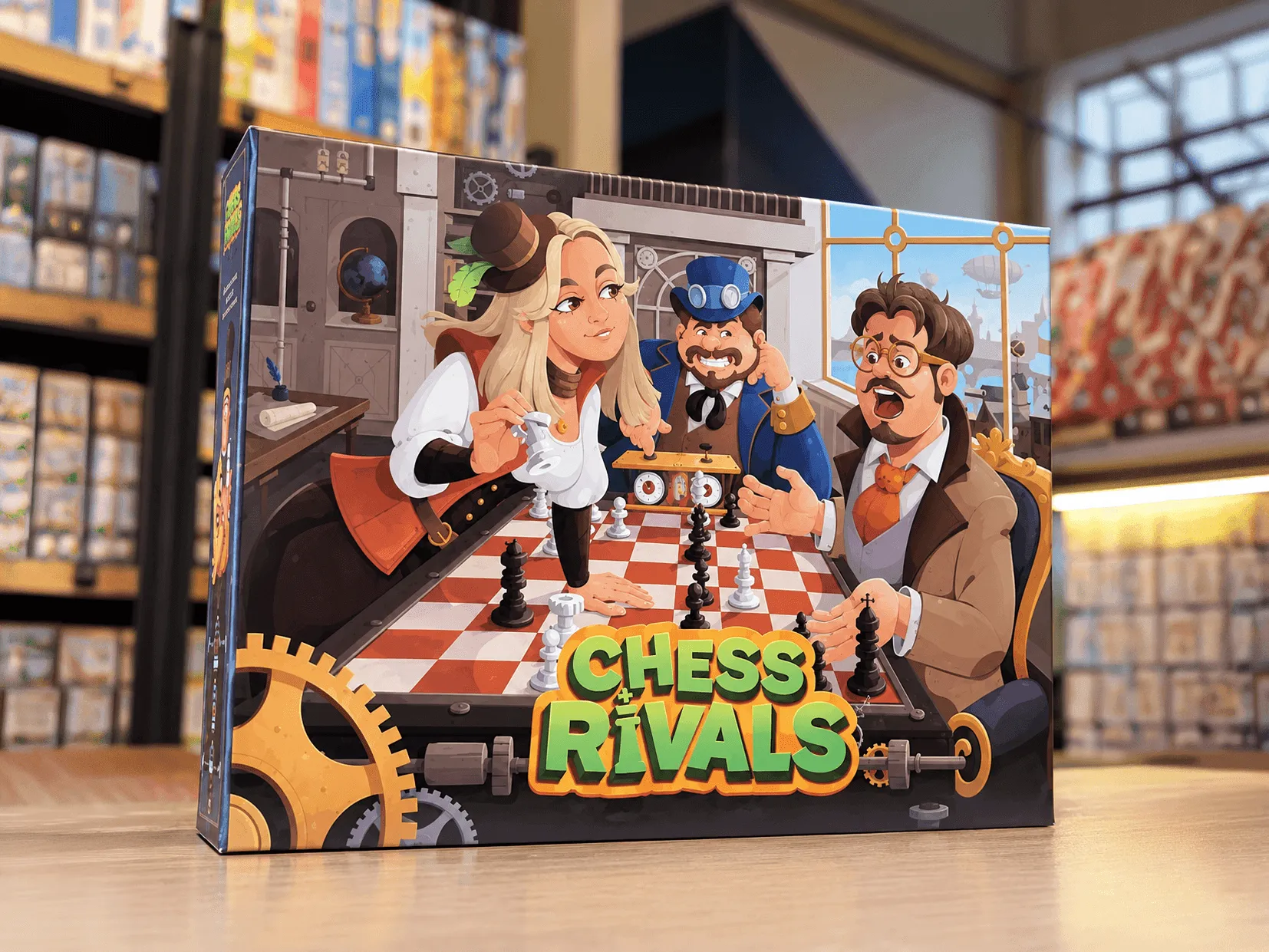
When Freddy Cheu brought us Chess Rivals, the brief was specific. Turn chess into a tactical card game. Keep the chess. Lose the board. Forty cards. One Victorian visual engine. Every card had to survive three contexts: held in a hand, fanned next to two other cards, laid flat under warm light. Most illustration pipelines optimize for one context. This one had to hold across three.
Chess pieces don't fit on cards until you shrink the right things
The first problem was not drawing chess pieces. It was making them legible at card size. A bishop at thumbnail scale needs to read as a bishop in half a second, the same way a character silhouette does on a mobile store listing. On Pirate Poker and Pirates War we learned this with pirate figures: lock the silhouette first, add ornament second, never the other way around. Chess pieces obey the same rule.
Workflow on each piece card ran in three passes. Silhouette exploration first, three to five thumbnails in solid black. Color pass second, palette locked against the in-game background, not against a plain studio sheet. Engraving texture third, applied only where the silhouette was already locked. Skip a pass and the card collapses into noise.


Victorian isn't a filter, it's a research folder
The Victorian era is not a sepia tone applied at the end. The look comes from specific choices: 1850s costume plates, club-room lighting, engraved portrait framing, the weight of ornament on a London chess club trophy from 1886. We built the reference folder from public-domain portrait engravings, fashion plates pulled from Peterson's Magazine archives, and championship photographs from the 1880s London tournaments that the game's lore references.
Decisions fell out of that folder. Typography went to engraved serif, not display sans. Borders picked up a corner motif borrowed from engraved portrait frames. Color temperature moved to warm ink on cream stock, never pure white, because pure white reads as modern printing and breaks the era. The folder shaped every card. Without it, "Victorian" would have been a costume, not a visual engine.
Silhouette first, ornament second
WOBL's silhouette test from character design applies directly to card art. Fill the piece in solid black. Stand across the room. If you can't name it, the silhouette failed. Six pieces had to read as six distinct silhouettes at card thumbnail size. The trick was the same one we use for character design: exaggerate one feature per piece, keep the rest grounded.
King owns the cross. Queen owns the crown points. Rook owns the battlements. Bishop owns the mitre slit. Knight owns the horse head curl. Pawn owns the round, low simplicity. A card with all six pieces ornamented equally reads as visual noise. A card where each piece owns one exaggerated shape reads as a set. That is the difference between an illustrated chess set and a chess-themed card deck.
Color has to survive a held hand and a table light
Card art is judged under three conditions the studio is not. Held in a player's hand at arm's length. Lit by a warm bulb overhead. Sitting next to two other cards in a fan. We test palettes against all three. Isolated on white, does the color sing alone. In a fan of three cards, do they fight. Under warm bulb, does the temperature hold.
The Victorian palette stayed in the ochre, burgundy, and cream family. High-saturation modern colors fought each other in fan formation. Soft ink on cream held its contrast across all three tests. Knight's accent blue went through six revisions before it survived the warm bulb test without turning purple. Pawn red failed twice on the fan test before we cooled it down.

Common questions
How many iterations does a single card take?
Three passes for the silhouette, two for the color, one for the engraving texture. A complex action card can run longer because the silhouette has to encode a chess tactic, not just a piece. A basic piece card locks faster since the visual language was already established in the first round.
Do you also design the box and rulebook art?
Yes, those are separate line items. The card art system feeds the box cover and the rulebook through the same Victorian visual engine so the entire product speaks one language. Box cover gets the engraved portrait treatment at hero scale. Rulebook diagrams get the same line weight and border treatment as the cards.
What software do you use for the final asset?
Procreate for sketch and silhouette. Adobe Illustrator for the line art and the engraved corner motif. Adobe Photoshop for the texture and the color grade. Final print-ready files go to the manufacturer as 300dpi CMYK TIFFs.
A chess piece on a card doesn't need to look like a chess piece. It needs to read like one across a table, under a warm bulb, in half a second. That's the whole job.
Back the campaign
Chess Rivals is live on Kickstarter now. For every backer, US$1 goes to the Naroditsky Memorial Fund, supporting the next generation of chess players in memory of GM Daniel Naroditsky.
Campaign page: Chess Rivals on Kickstarter →